imgskit Journal
The 2026 AI Image Model Showdown: Nano Banana, GPT Image 2, and Midjourney V7
AI image generation has evolved faster in the past twelve months than in the entire decade before it. What used to require professional software, a steep learning curve, and hours of iteration can now happen in seconds with a single text-to-image prompt. But with so many powerful AI generators competing for your attention — and your workflow — it's worth understanding what each one actually does well, and where it falls short.
This breakdown covers three of the most talked-about models right now: Google's Nano Banana, OpenAI's GPT Image 2, and Midjourney V7. Whether you're a solo creator, a marketing team, or a developer building image pipelines, knowing the differences will save you time, money, and a lot of frustrated regenerations.
Nano Banana: Google's Iterative Image Engine
Google entered the AI image generation space with a tool that feels distinctly different from its competitors — and that difference is intentional. Nano Banana (Gemini 3.1), first released in August 2025 and now on its second major version, is built around a chat-based, iterative editing experience rather than a single-shot generation model.
Nano Banana lets users generate and refine visuals through natural language prompts in the same way you'd have a back-and-forth conversation. You don't generate an image and start over — you generate, describe what you want changed, and the model updates it while preserving everything else. This iterative workflow makes it particularly strong for users who aren't sure exactly what they want at the outset and need to explore ideas gradually.
The February 2026 release of Nano Banana 2 (Gemini 3 Pro) pushed the product further. It introduced real-time information grounding from Gemini, pulling in current knowledge to produce more contextually accurate results. It's also noticeably faster, with improved text rendering that makes it usable for marketing mockups and greeting cards — tasks where text legibility in images matters.
Where Nano Banana Pro (Gemini 3 Pro) separates itself from the standard version is in factual fidelity and high-stakes outputs. Google is keeping the Pro tier available specifically for cases where accuracy and SynthID watermarking are non-negotiable, such as commercial, compliance-sensitive work.
The main caveat is ecosystem lock-in. Nano Banana lives inside the Gemini app and Google Workspace, which makes it seamless for existing Google users but limits flexibility for people who want to use it in standalone or cross-platform workflows.
Best for: Iterative creative exploration, Gemini-integrated workflows, and users who want a conversational editing experience over a one-shot generation model.
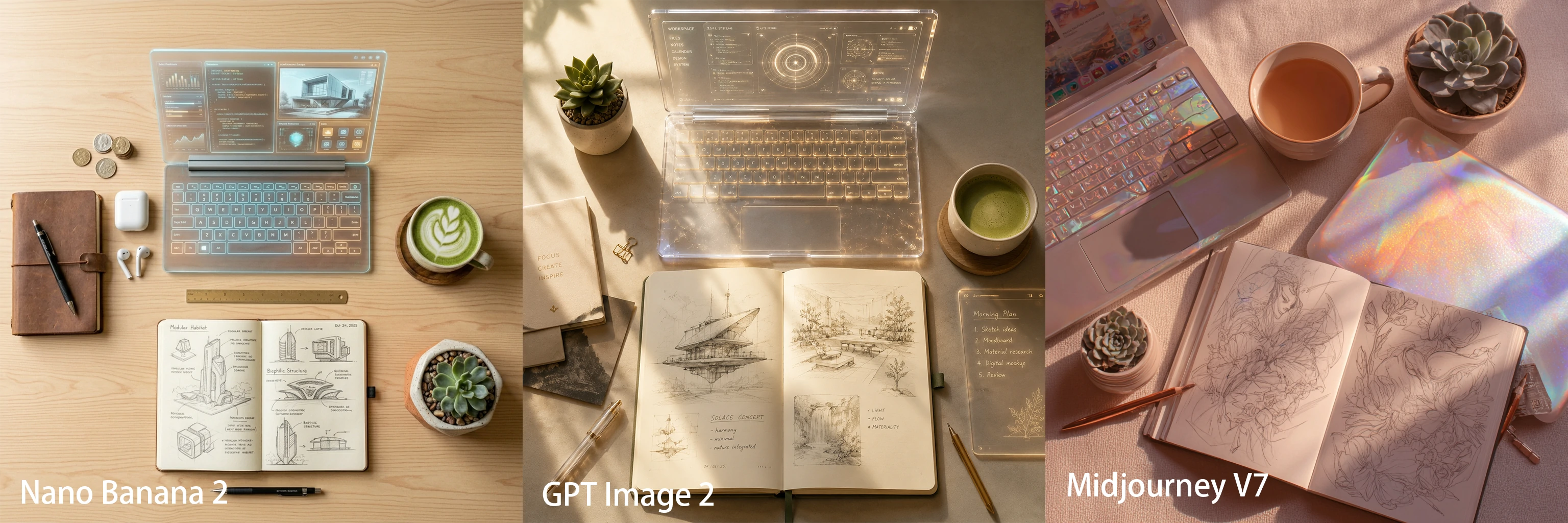
Model Comparison — Complex Multi-Element CompositionNano Banana (Gemini 3.1) / GPT Image 2 / Midjourney V7 Prompt: "A futuristic workspace flat lay: a holographic laptop, a cup of matcha, an open sketchbook with pencil drawings, a small succulent plant, soft morning light from the left, top-down view, cohesive warm color palette"
GPT Image 2: The Reasoning-First Image Model
OpenAI dropped GPT Image 2 on April 21, 2026, and it immediately claimed the top spot on every major Image Arena leaderboard. The launch was quiet — no countdown, no keynote — but the results spoke loudly enough.
The defining feature of GPT Image 2 is something that sets it apart from every other model in this comparison: O-series reasoning applied to image generation. Before rendering a single pixel, the model researches the prompt, plans the composition, and self-checks its output against the original instructions. This makes it the first genuinely agentic image model — one that thinks before it draws rather than drawing and hoping for the best.
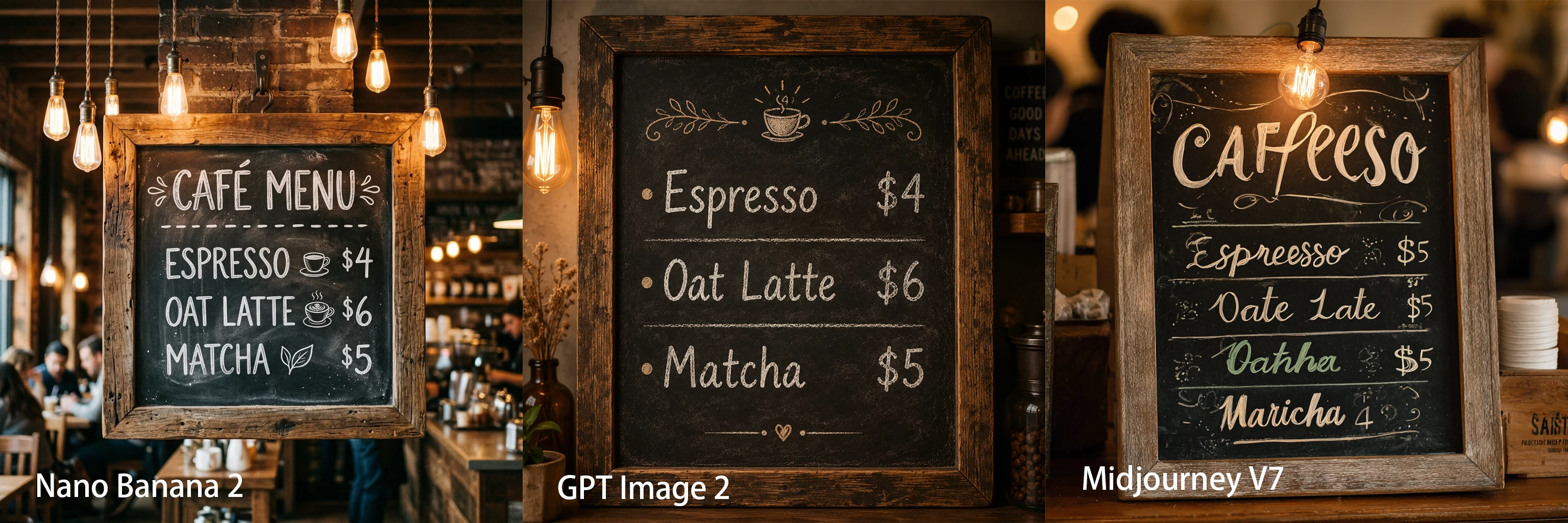
The practical result of this architecture is near-perfect text accuracy across multiple languages, including Japanese, Korean, Chinese, Hindi, and Bengali. For any output where legibility of in-image text matters — infographics, UI mockups, multilingual posters, product labels — GPT Image 2 is in a category of its own. It also doubles as a capable AI photo generator for realistic scene compositions, handling complex multi-element layouts with a coherence that previous models consistently struggled with.
Resolution tops out at 2K natively, with aspect ratio support ranging from ultra-wide 3:1 to tall vertical 1:3, covering everything from cinematic banners to mobile-first content. OpenAI's decision to shut down DALL-E 2 and DALL-E 3 on May 12, 2026 underlines how confident they are in this model — GPT Image 2 is now their only image offering going forward.
The trade-off is speed. Agentic reasoning takes longer than direct rendering, so if you're running a high-volume pipeline that needs instant turnaround, that latency matters. And while the instruction-following is exceptional, Midjourney still has an edge in pure artistic photorealism and stylistic flair.
Best for: Text-in-image tasks, complex multi-element compositions, multilingual content, and developers who need reliable instruction-following via API.
Model Comparison — Text RenderingNano Banana (Gemini 3.1) / GPT Image 2 / Midjourney V7 Prompt: "A vintage-style cafe menu board with handwritten-look chalk text listing three items: 'Espresso $4', 'Oat Latte $6', 'Matcha $5', dark chalkboard background, warm Edison bulb lighting, rustic wooden frame border"
Midjourney V7: Still the Artistic Standard
Released on April 3, 2025, and made the default model on June 17, 2025, Midjourney V7 represents a complete architectural rebuild — not an incremental update. CEO David Holz described it as "a totally different architecture," and that claim holds up in practice.
The most significant improvement over V6 is prompt adherence. V7 interprets prompts more literally and precisely, which means fewer creative surprises when you ask for something specific. This is a shift in philosophy: earlier Midjourney versions were known for taking liberties with prompts in ways that sometimes produced brilliant results and sometimes produced frustrating ones. V7 leans toward precision while still maintaining the aesthetic richness the platform is known for.
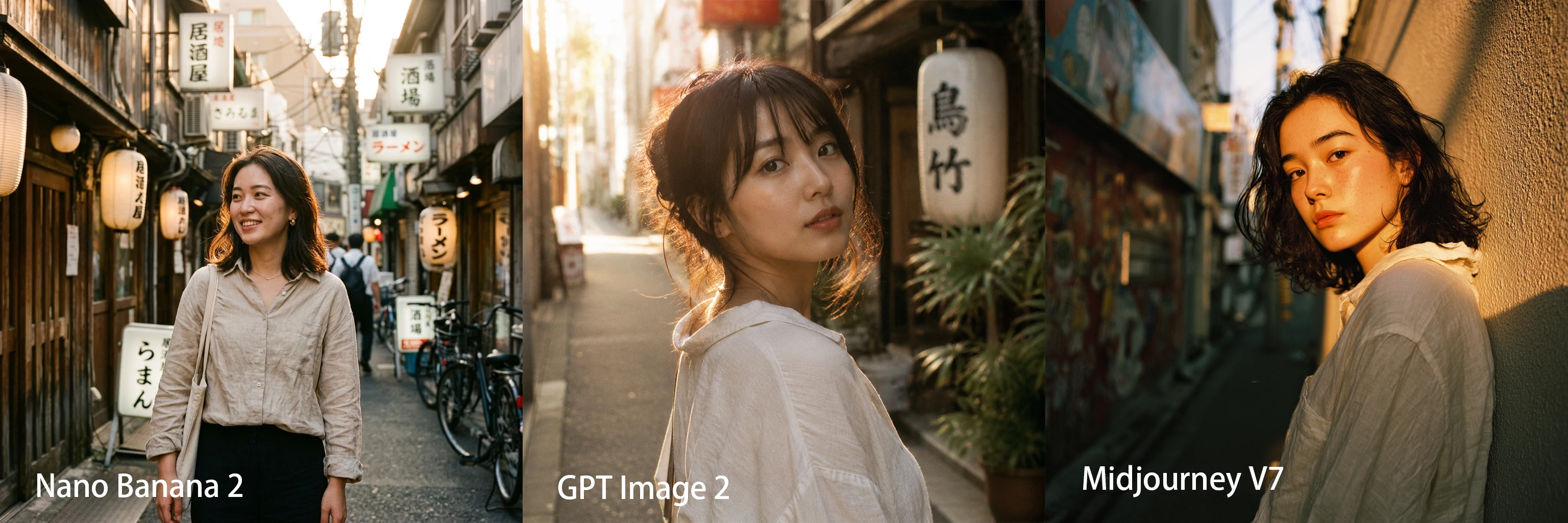
Text rendering has also improved meaningfully, though it still trails GPT Image 2 for long strings of text. Where V7 genuinely leads is photorealism — particularly in human subjects, hands (historically the Achilles heel of AI image generation), and fine textures. The results are consistently portfolio-ready, with compositions and color grading that feel designed rather than generated.
Two features introduced with V7 are worth highlighting for professionals. Draft Mode generates rough compositions at roughly 10x the speed and half the GPU cost of standard generation, which changes how creative exploration works. Teams can now iterate through dozens of rough directions cheaply and only spend compute on the promising ones. Omni Reference extends this further, enabling consistent reference handling across a project.
For anime and illustration specifically, Niji V7 — released in January 2026 — brings the same architectural improvements to Midjourney's anime-tuned model, with better coherence, prompt understanding, and style reference performance.
Midjourney still requires a paid subscription, and the Discord-based interface remains a point of friction for users who prefer a traditional app experience. But for pure artistic output, nothing currently matches it.
Best for: High-quality artistic and photorealistic outputs, portfolio work, and creative teams who can use Draft Mode for fast ideation before committing to final renders.
Model Comparison — Photorealistic PortraitNano Banana (Gemini 3.1) / GPT Image 2 / Midjourney V7 Prompt: "Portrait of a young woman in a sunlit Tokyo alley, golden hour lighting, film grain, natural skin texture, loose linen shirt, candid expression, shot on 35mm"
Getting Hands-On Without Switching Between Tools
One thing that becomes apparent when working across multiple models is how much friction comes from jumping between platforms. You might generate a base image in one tool, want to refine it in another, and then need to edit the result — all in different tabs with different interfaces and different prompt conventions.
ImgSkit addresses this directly. It's an online AI image generator and editor that lets you create new visuals from text-to-image prompts, refine uploaded photos, and run a flexible AI photo editor in a single workflow — with a free tier to get started, making it one of the more accessible free AI image generator options for creators who want to test ideas before committing to a plan. If you've generated something in Nano Banana or Midjourney and want to extend it, adjust specific elements, or use it as a starting point for something new, ImgSkit handles that without forcing you to re-export, re-format, or re-prompt from scratch. It's particularly useful as a bridge layer in creative workflows that span multiple AI generators.
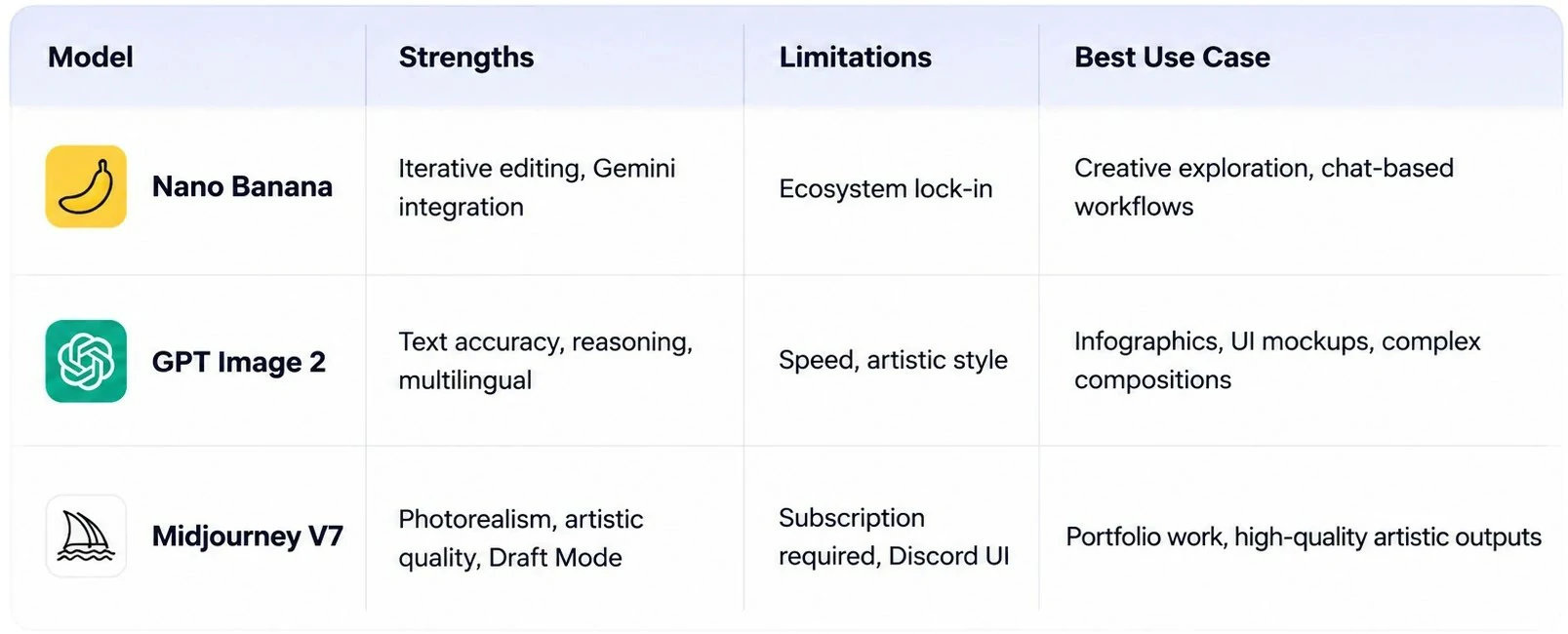
How They Stack Up
Which Model Should You Use?
The honest answer is that no single model wins across every use case in 2026. The field has matured to the point where each major tool has a clear specialization, and the most effective workflows tend to combine models rather than commit to one exclusively.
If text accuracy and instruction-following are your priority — infographics, UI mockups, multilingual posters — GPT Image 2 is the current leader. If artistic quality and photorealism matter most, Midjourney V7 still sets the bar. And for users who want to explore ideas conversationally and refine images iteratively without leaving the Google ecosystem, Nano Banana offers an experience that the others don't match.
The good news is that experimenting across AI image generators has never been more accessible. Start with the output that fits your immediate need, and build from there.